What Your Money Actually Buys in Ascaya: Reading Past the Median in 2026
July 16, 2026
July 16, 2026
In April 2026, Raiders owner Mark Davis closed on four adjacent homesites in Ascaya for roughly $38.75 million, stitching together about 19.2 acres beside a three-story estate he already had under construction. It is the kind of transaction that tells you more about how Ascaya actually prices than any median ever will.
The MLS-derived snapshot for June 2026 puts Ascaya's median list price near $9.84 million, with average pricing around $1,363 per square foot and roughly 122 days on market. Those numbers are accurate and, on their own, close to useless. Ascaya sells at least three distinct products behind one guard gate, and the median blends them into a single figure that does not describe any of them.
Before comparing Ascaya to MacDonald Highlands or Roma Hills on a per-square-foot basis, it helps to separate what is actually being sold inside the 313-homesite community.
| Product | What it is | Price band (2026) | Typical size |
|---|---|---|---|
| Estate Homesite Collection | Raw lots terraced into the McCullough Mountain Range | From $1M | ~0.5 to 2+ acres |
| Cloud Rock Collection | 58 ridge-top homesites with 360° views over the valley and Sloan Canyon National Conservation Area | $2M to $8M | 1.6 to 3.34 acres |
| Canyon Residences at Ascaya | Blue Heron semi-custom, lock-and-leave homes on the community's west side | From ~$2.9M at launch, resales trending higher | 3,391 to 4,407 sq ft |
| Custom finished estates | One-off architect-designed homes on Estate or Cloud Rock lots | ~$4.1M to $19.5M+ currently listed | ~4,400 to 9,800+ sq ft |
A buyer comparing Ascaya to another guard-gated Henderson enclave on median price is comparing a weighted average of raw land, semi-custom production luxury, and one-off custom estates against whatever mix the other community happens to be selling that quarter. The comparison rarely means what buyers think it means.
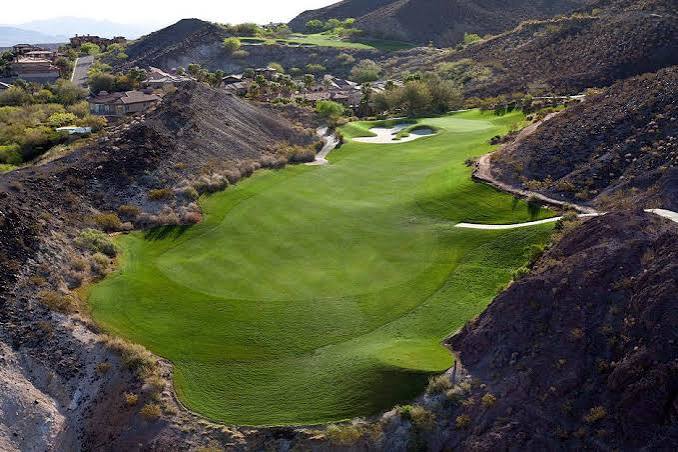
Look inside the numbers and the driver becomes clear. Cloud Rock sites sit at the community's highest elevations, along the uppermost ridgelines of the McCullough range, and command $2 million to $8 million for 1.6 to 3.34 acres. On a per-acre basis, a Cloud Rock parcel can price four to five times a lower Estate lot of comparable topography.
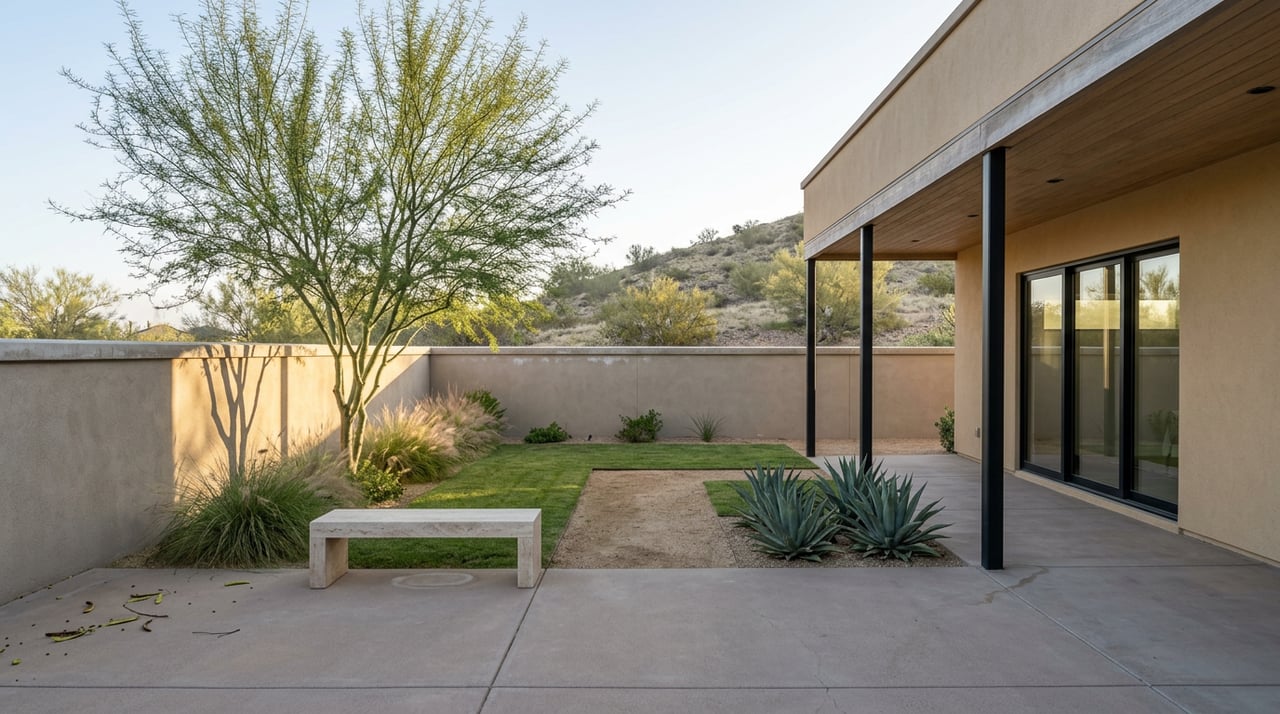
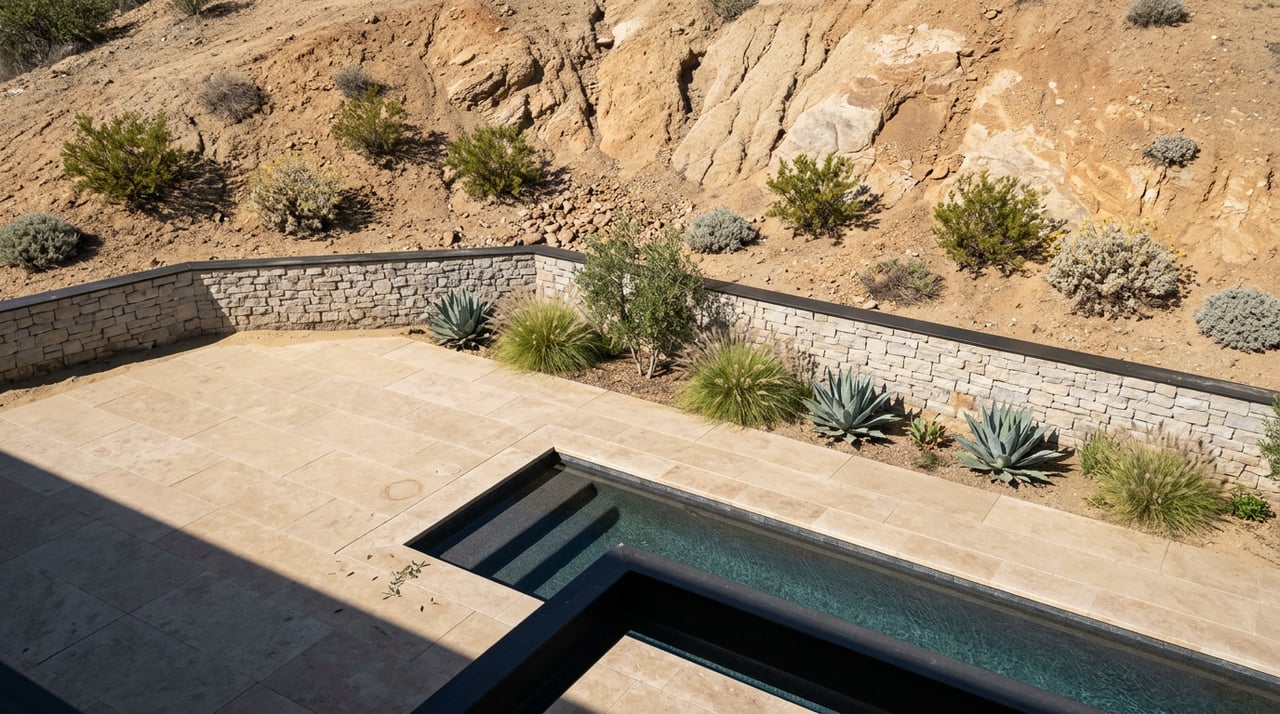
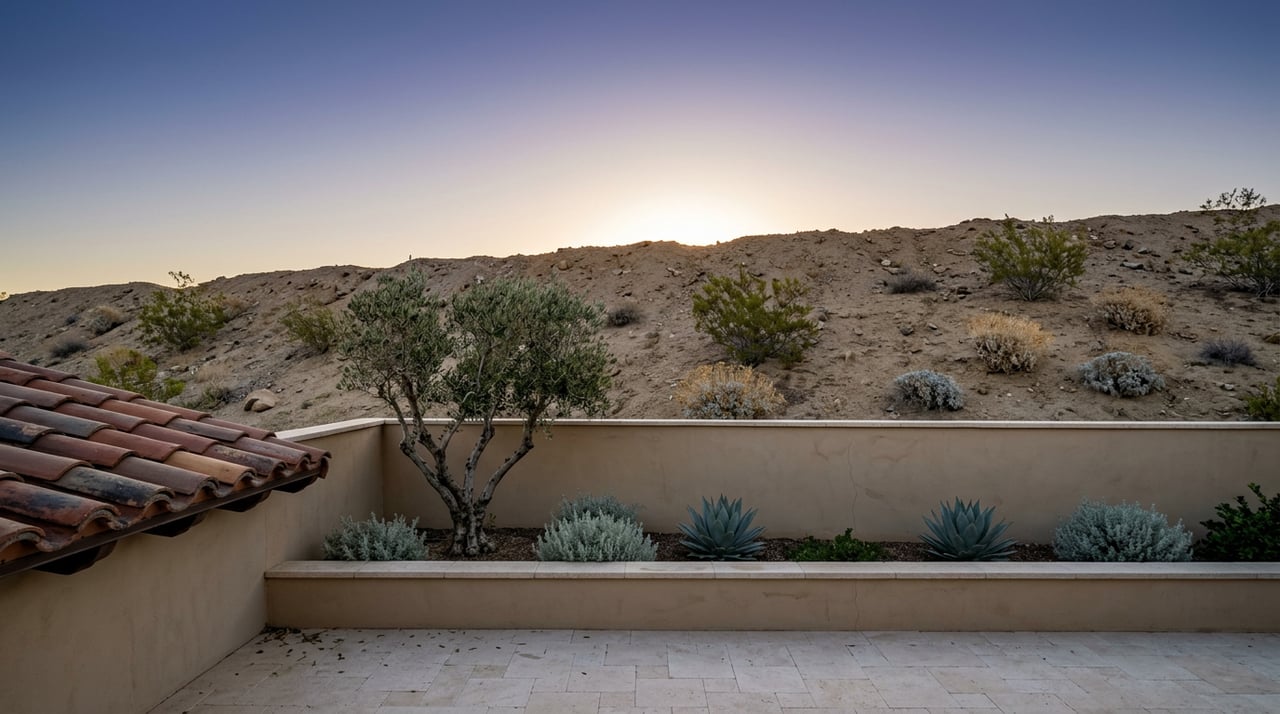
The reason is not turf or trees. Ascaya is xeric mountain desert. The premium buys sight lines — an unobstructed 360-degree view spanning the Las Vegas Valley on one side and the protected Sloan Canyon National Conservation Area on the other. Because Sloan Canyon is federally protected, the southern and western views cannot be built out later. That view scarcity is what a Cloud Rock price is capitalizing.
This matters for a buyer's comps math. Two homes of identical square footage inside Ascaya can transact at meaningfully different per-square-foot numbers depending on elevation band and view orientation. A buyer using neighborhood-average $/sq ft to underwrite an offer on a specific ridge lot is using the wrong denominator.
Most Ascaya buyers are not spending $38.75 million on land. The Davis transaction still tells them something material.
Contiguous parcels with usable topography and unblocked views are the scarce resource in Ascaya, not square footage. When a single buyer takes four of them off the market at once, the remaining inventory of adjacent view lots on that side of the community becomes noticeably thinner. Ascaya markets the community as 313 homesites total, and with development continuing since the mid-2010s, the pool of large, contiguous, view-oriented parcels is a small fraction of that number.
For a buyer at a lower price point, the read-through is not that prices are about to jump valley-wide. It is that flexibility on lot choice inside Ascaya has narrowed. If a specific view orientation matters, waiting a year to negotiate a better cap-rate cycle may cost the buyer the lot they wanted more than the discount is worth.
Ascaya imposes no build-timeline requirement on homesite owners, and homesite owners get full clubhouse access from day one. Compared with luxury communities that force construction within twelve or twenty-four months of closing, this is genuinely unusual.
It is also the source of the community's least-discussed transaction friction.
The reason many Ascaya lots sit on market for extended periods is that supply and demand cross at a hazier point when no clock is forcing anyone to build. An owner can carry a lot for years while amenities, HOA dues, and land taxes accrue against a still-undeveloped parcel. When that owner eventually sells, they are competing not only with active resale lots but with any Cloud Rock or Estate inventory the developer still holds. Days on market at the current 122-day average reflects, in part, that structural patience on both sides of the trade.
For a buyer, three practical consequences follow:
The Canyon Residences, Blue Heron's lock-and-leave project on the west side of Ascaya, launched pricing around $2.9 million for homes of 3,391 to 4,407 square feet. Resales on the current MLS sit in the low $4 millions.
They should not be compared to Ascaya custom estates on a per-square-foot basis, and the comp software will not automatically know that. Canyon Residences are semi-custom, share pools and event pavilions, and have HOA-managed landscaping across the sub-community. Ascaya's freestanding custom estates are one-off architectural commissions — the community's first completed home, a Marmol Radziner design, is a 7,555-square-foot project designed as its own object, not as part of a repeating architectural language.
The right comp set for a Canyon Residence is other Canyon Residences and, at the margin, lock-and-leave product in MacDonald Highlands or the Ridges. The right comp set for a custom Cloud Rock estate is Ascaya's own custom sales history, filtered to a similar view band. Mixing the two collapses back into that misleading $9.84 million median.
Two buyers walking into Ascaya with identical budgets will end up with materially different assets depending on what they confirm before offer.
Is Ascaya priced comparably to MacDonald Highlands?
On raw median list, the two communities look similar in 2026. The mix of what is selling is different. Ascaya's median is being lifted by ridge-oriented custom estates and Cloud Rock land; MacDonald Highlands mixes established resales, new custom construction, and the forthcoming Four Seasons Private Residences Las Vegas condominium product. Compare like assets, not medians.
Do homesites appreciate independently of built homes?
Historically in Ascaya, they have moved on their own supply-demand curve, particularly for contiguous parcels and Cloud Rock view sites. The Davis assemblage is the most public recent data point, but smaller two-lot combinations trade quietly with some regularity.
What is the practical difference between an Estate lot and a Cloud Rock lot?
Elevation, view radius, and price. Cloud Rock sits at the top of the community with protected views over Sloan Canyon on one flank. Estate lots range across mid-mountain positions. Both share full clubhouse and amenity access.
How long does a custom build typically take from lot close to move-in?
Design Review, architect selection, engineering for hillside sites, and construction on graded pads together mean most buyers should plan on a multi-year timeline. This is a factor buyers underweight when they compare Ascaya land pricing to finished-home pricing elsewhere in Henderson.
The number that describes Ascaya is not the median. It is the price a serious buyer just paid for adjacency and a view corridor that cannot be replicated. Reading past the median means separating land from house, view band from elevation band, and one-off custom from Blue Heron semi-custom before any offer gets written.
If you are evaluating Ascaya against MacDonald Highlands, Dragon Ridge, or Roma Hills, or weighing a Cloud Rock lot against a finished Canyon Residence, Prescindia Misch can walk the specific parcel, pull the right comp set, and read the trade with the discretion these transactions require. Request a private consultation.
Stay up to date on the latest real estate trends.
Lifestyle
First, the part that surprises everyone: who gets access to what